

If your organizational strategy sets the direction, or the “where you’re going,” then your culture is the “how you’re going to get there.” When businesses are facing major strategic shifts, culture has the potential to either enable or undermine their performance.
We work with executive leaders to understand what exceptional performance at their organization could look like, where they could perform at a higher level and how their current culture both serves and challenges those imperatives.
When we partner with organizations to support culture transformation – the process of aligning the what and the how to enable higher performance – we always start by getting a clear picture of your current culture, including its opportunities and limits.
In this post, we’ll explore how you can understand your organization’s culture and share our recommendations for this approach.
What is culture?
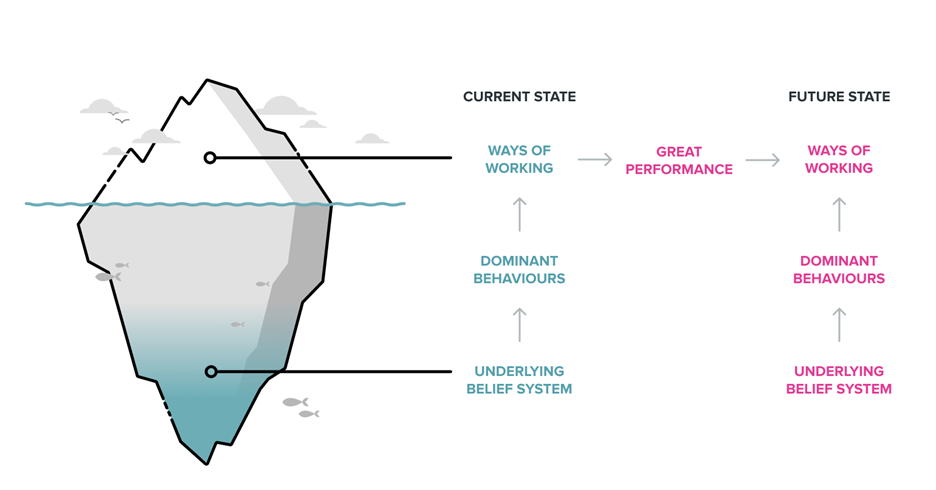
We love to use the iceberg metaphor popularized by Edgar Schein. Our visible ways of working – what we do and experience on a day-to-day basis – sit above the water line. They make up the part of the iceberg you can see from far away. This is what people typically associate with culture.
But below the water line, there’s an invisible system that’s driving all of our daily experiences. This makes up the bulk of the iceberg. It’s not readily visible, but it’s holding the culture in place. In organizational culture, this invisible system is employees’ beliefs, their shared mental model of how the world works that they’ve built up over time. It’s this belief system that drives the dominant behaviours in a culture.
So, to build the culture you want, you need to change this underlying system. But it all starts with an understanding of your current culture.
Comparing methods – why surveys aren’t enough
When organizations want to understand their current culture, they might reach for a survey-based tool that includes specific questions designed to measure the alignment between employees’ values and their experience at work. These one-size-fits-all tools seem like an easy, economical way to get quick insights.
While surveys may provide helpful data and patterns about your existing systems, they do have their limitations:
- They capture opinions, not underlying beliefs – What people say and what they do rarely adds up. Culture is a belief system that sits in the back of people's minds and it's invisible to people in the culture. Understanding opinions (that sit in the front of people’s minds) alone will not uncover the deeper insights that drive culture change.
- They lack objectivity – Your biases and the limitations of your understanding are built into the survey questions. Those limitations are even greater when your survey questions come from a third party who lacks an intimate understanding of your culture and how it works. With surveys, you're starting with a hypothesis or a mental model, which you test by asking people what they think about it.
- They can be overused – Too many surveys can wear people out. Contrast this with the experience of being involved in empathetic research, where employees’ stories are heard; it’s enriching and wonderful for people, and it's also part of the change that happens.
Mixed methods approach
Instead of relying solely on surveys, we recommend using a mixed methods approach that explores attitudinal insight (what people are saying), as well as the behavioral insight (what people are doing). This ensures you uncover the root causes of your current culture, so you can address core issues instead of focusing on surface symptoms.
In a mixed methods approach, we use quantitative data, qualitative interviews, and workshops to engage with demographically representative employees from across the organization to unearth the current system of beliefs that drive how work gets done.
Empathetic interviews can be especially insightful, because they help you go beyond demographic information to understand people at a human level. A skilled researcher can surface the highs and the lows of people’s experiences in nuanced detail, then synthesize themes that create a high-resolution picture of what's going on.
These different methods provide the information we need to:
- Identify current beliefs and ways of working that contribute to your culture and performance today and into the future.
- Identify the limiting beliefs and behaviours that hold your organization back from its potential performance.
- Capture leaders’ perspectives on performance gaps and map them to ways of working.
- Identify key opportunities for executives to model ways of working that will stimulate higher performance.
Co-creating a culture blueprint
Results of mixed methods research gives you the clarity you need to design a new culture and your way forward. When we partner with organizations, this involves co-creating a culture blueprint that:
- Reinforces the strengths of the culture that got you where you are
- Identifies how beliefs will need to change to drive the behaviour needed for your future culture
- Maps the gaps between your current and future culture to a to-be system of beliefs
It’s important at this stage to provide board members and senior leaders with tools they can use to lead with the to-be culture in mind, support learning and model the change for all employees.
Leadership is key
It’s critical that culture change comes from the top level of your organization. Anyone who gives high-level direction should be endorsing, promoting and living the culture change. Without commitment for change from senior leadership, the rest of the organization won’t believe that anything will happen or change. Executives play an engaged role throughout the process – from initiating research and clearing obstacles to deciding on the changes they want to make and bringing them to life.
Precision leads to momentum
Getting a clear picture of your current culture empowers organizations to move forward and make decisions with much more precision, because they have a deeper understanding of the exact changes they need to make. Instead of managing symptoms of their culture, they’re addressing the root cause. This builds momentum and helps people adopt change more quickly and easily.
Though the research is done, this is just the start of your culture journey. You’re now equipped to start designing the future culture for your organization.